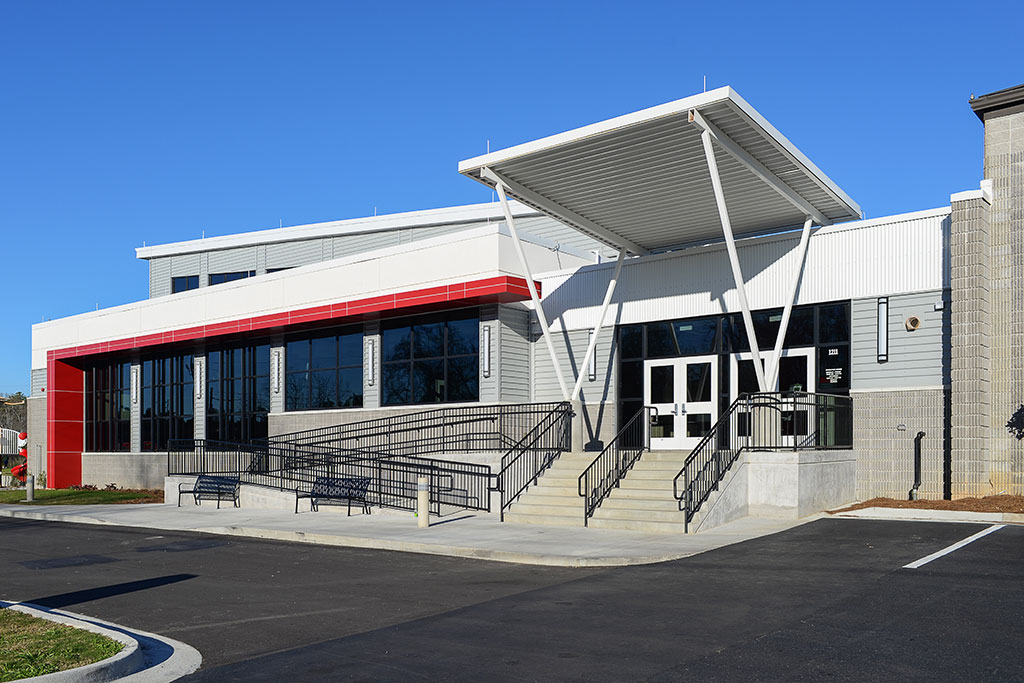
The Family Counseling Center of Central Georgia (FCC) is hosting a Community Festival at Rosa Jackson Recreation Center (1211 Maynard Street) on Saturday, November 9, 2024. It’s free and open to everyone from 11:00 a.m. until 4:00 p.m. FCC is also looking for volunteers to help out at the festival.
Families and people of all ages are invited to join in on the fun, food, and games. November is recognized as Early Childhood Mental Health Awareness Month.
“The goal of the event is to raise awareness for early childhood mental health by including non-profit partners who will provide information and resources to those who attend,” said FCC Executive Director Christy Henry. “We are accomplishing this in conjunction with a free, fun and safe event for children and families.”
The festival is carnival themed, and FCC is asking nonprofit partners and organizations to host a carnival game during the event. (Nonprofit partners are not required to host a game and can just provide resources). Interested agencies and organizations must provide their own game and prizes. Please keep in mind this event is geared towards families and children of all ages. Due to the large size of the event, they ask that organizations bring their own tables and chairs. Volunteers will be available to help load and unload. If you would like to sign up, click here.
‘The event is incredibly important to us as we work to provide resources to our community and break down stigma related to mental health and the importance of making mental health a priority,” said Henry. “We often work with clients who experienced several ACEs (adverse childhood experiences) so we want to create an opportunity for a positive childhood experience.”
The event is in honor of Chsandra Johnson to recognize the work she did in the community to advocate for mental health services for everyone. Johnson was the case manager at Family Counseling Center and very involved in the east Macon community.
Georgia is ranked 47th in the country regarding access to mental health care. This event is to promote FCC and other non-profits who support individuals with their mental health and basic needs, promoting health individuals and larger community as a whole.
FCC is also a Macon Violence Prevention (MVP) grant recipient, receiving $40,000 to provide resources equivalent to a full-time therapist’s workload, encompassing approximately 1,000 direct client contact hours and an additional 1,000 hours for preparation and follow-up tasks. These resources will facilitate individual therapy sessions for at-risk populations prone to crime involvement and specialized group sessions for parents of at-risk children. Click here to learn more about MVP. 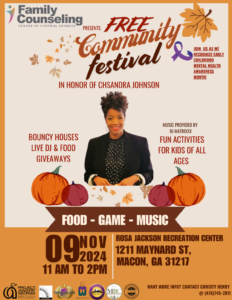
About the Macon Violence Prevention Program
Macon Violence Prevention is an evidence-based, multifaceted program created to address public safety in Macon-Bibb County. Supported and funded by the consolidated government, MVP is a community-wide effort that brings together elected officials, community leaders and representatives from more than 20 agencies, organizations and departments.
This summer, Macon-Bibb and the Community Foundation of Central Georgia announced more than $800,000 in grant money for 25 non-profit organizations. Since the inception of MVP in 2021, $1,685,000 has been awarded to 40 different organizations’ missions.
Though MVP is still fairly new in its implementation, it has already helped the community realize significant results in becoming safer. From 2022 to 2023, Macon-Bibb had a nearly 43% reduction in homicides, from 70 to 40. The reduction in homicides for children (those 18 years old and younger) went from 15 in 2022 to 5 in 2023 – which is a 66.7% reduction in just one year.
While other cities in Georgia and around the country also had a decline in their homicide rate, Macon-Bibb County’s 43% far surpassed them. Atlanta had a 21% decline, Columbus a 12%, Savannah a 13%, Mobile, Alabama a 21%, and Jackson, Mississippi a 14%.
The MVP program operates under the guidance of the MVP Strategic Plan, which was introduced in June of 2021. Created by community stakeholders and violent crime experts, this strategic plan combines data and research with community feedback to implement proven solutions that reduce violent crime and strengthen the community over time.